
Alopecia areata
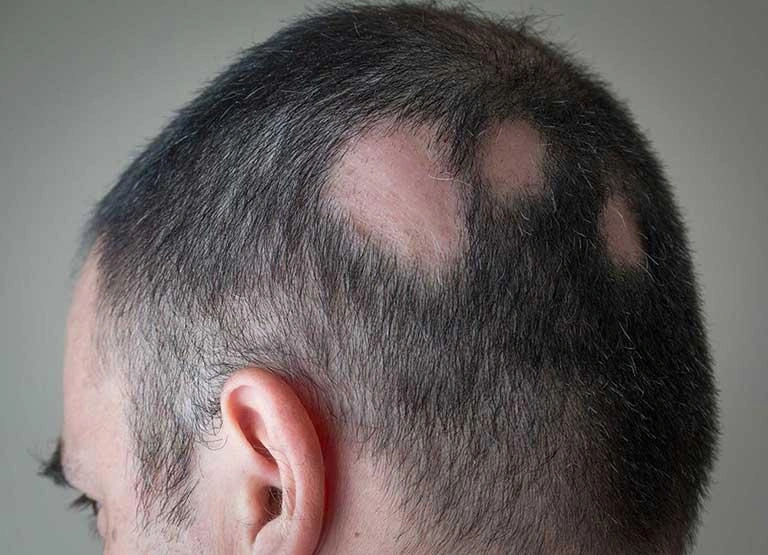
Alopecia areata is a common autoimmune disease that causes hair loss, usually in small, round areas of the scalp, although, in some cases, it may also lead to generalized baldness. Skin patches affected by hair loss usually look normal and, although any hair of the body may be involved, these usually appear in the scalp and the beard.
At any given time, approximately 0.2% of the world population is suffering from alopecia areata. It has an estimated lifetime risk of 1.7%; it is a common cause of abrupt-onset hair loss but occurs less often than androgenetic alopecia or telogen effluvium. Both sexes are equally affected. Although it may occur at any age, incidence at younger ages is higher.
Alopecia areata is the most common form of alopecia seen in children. Familial occurrence is approximately 15%, but expression of the disorder is variable between different family members. Of patients suffering from alopecia areata, 5% develop hair loss of their entire scalp hair (alopecia areata totalis) and 1% develop alopecia areata universalis (loss of total body hair).




Alopecia areata manifests through different clinical patterns ranging from common patchy hair loss to the more severe alopecia totalis (complete scalp loss) and alopecia universalis (complete scalp and body loss), as well as atypical variants like diffuse thinning and the treatment-resistant ophiasis pattern. While these presentations vary in extent and prognosis, they represent different expressions of the same underlying disease process rather than distinct pathologies.
What causes alopecia areata?
Alopecia areata seems to have its origins in the immune system. Deregulation of the immune system makes it attack the follicles with growing hairs in certain areas of the scalp. Since only the hairs in growth phase are attacked, the follicles with hairs that are not in growth phase remain intact. Attacked follicles only lose the hair growing at that time, so they don't lose the ability to generate new hairs or to re-enter the hair production cycle.
The specific triggers of alopecia areata are not unknown, but it seems that emotional or physical stress, virus infections, or drugs may be involved. Furthermore, alopecia areata is often triggered in patients with other types of autoimmune diseases, such as lupus, vitiligo, psoriasis, or rheumatoid arthritis.

How is alopecia areata diagnosed?
The diagnosis of alopecia areata is primarily a clinical process involving a physical assessment of distinctive non-scarring, smooth, oval patches of hair loss, often supplemented by trichoscopy to identify pathognomonic markers such as 'exclamation mark' hairs and yellow dots. A thorough medical history and the hair pull test are essential for determining disease activity, while more invasive procedures like scalp biopsies or blood panels (targeting thyroid function or broader autoimmunity) are reserved for atypical presentations or to exclude differential diagnoses like tinea capitis and cicatricial alopecia.
How to detect alopecia areata?
The start of the disease is usually very fast, and either stops after the appearance of one or more patches, or progresses and induces generalized baldness all over the scalp, or even all over the body. The shape of the hair is very characteristic: near the edges of the patches or bald spots, the so-called 'exclamation mark hairs' can be found.
References
- Kang, S., Amagai, M., Bruckner, A.L., Enk, A.H., Margolis, D.J., McMichael, A.J., Orringer, J.S. Fitzpatrick’s Dermatology. McGraw Hill. 9th. ed. Buenos Aires, Argentina: Editorial Médica Panamericana S.A.; 2009. 720 p.
- Otberg, N., Shapiro, J. Chapter 87: Alopecia Areata [Internet]. 2019. Available at: https://accessmedicine.mhmedical.com/content.aspx?sectionid=210420857&bookid=2570&Resultclick=2
- National Alopecia Areata Foundation (NAAF). What you need to know about alopecia areata [Internet]. [Cited 2020 Mar 10]. Available at: https://www.naaf.org/alopecia-areata
- American Academy of Dermatology (AAD). Alopecia areata: overview [Internet]. [Cited 2020 Mar 10]. Available at: https://www.aad.org/public/diseases/hair-loss/types/alopecia
- Lehrer, M. Alopecia areata. MedlinePlus [Internet]. 2018 Oct 10. Available at: https://medlineplus.gov/ency/article/001450.htm
- Harvard Health Publishing, Harvard Medical School. Alopecia Areata [Internet]. 2019 Jan. Available at: https://www.health.harvard.edu/a_to_z/alopecia-areata-a-to-z