
Alopecia areata types
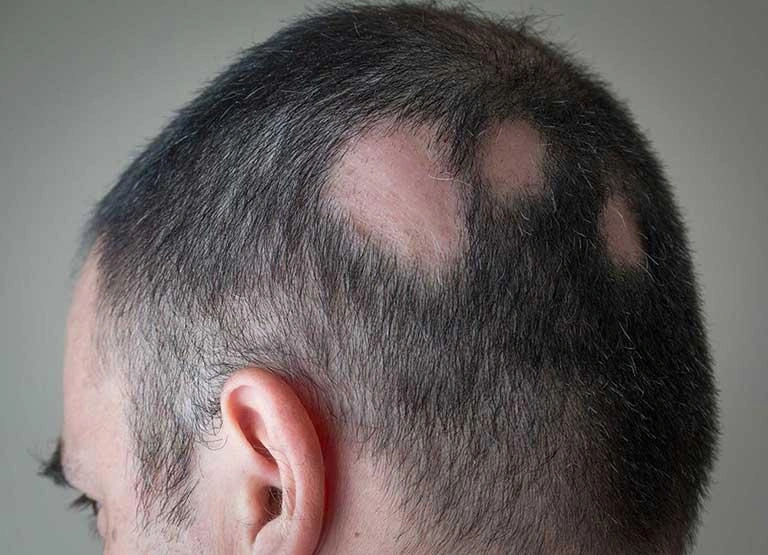
How many types of alopecia areata exist?
There is no single, universally agreed list of types of alopecia areata, but several clinical patterns are widely recognized. The most commonly described forms are patchy alopecia areata, alopecia areata totalis, alopecia areata universalis, diffuse alopecia areata, and ophiasis alopecia. These patterns can sometimes overlap or change over time in the same person. Rather than being separate diseases, they are considered different ways in which the same underlying autoimmune process can present and evolve.
Alopecia areata (patchy)
This is the most common type of alopecia areata. It presents as one or more round or oval areas of hair loss on the scalp or on other parts of the body where hair normally grows. These bald patches usually have smooth, healthy-looking skin and do not show signs of scarring.
Because the hair follicles remain intact, regrowth is possible. Many people experience periods of hair loss followed by regrowth, although the pattern can be unpredictable and may recur over time.
During diagnosis of alopecia areata, clinicians look for the typical circular or oval patches, sometimes accompanied by very short, broken hairs at the edges, and visible follicular openings, both features that help distinguish this form from other types of hair loss.
Alopecia areata totalis
Alopecia areata totalis is a more advanced form of the condition, in which all hair on the scalp is lost. It may develop gradually from smaller patchy areas or, less commonly, appear suddenly without an initial patchy phase.
The outlook for alopecia areata totalis is generally less favourable than for the patchy form, as spontaneous regrowth is less common and tends to be slower. Although hair follicles remain alive and capable of producing hair, recovery is not guaranteed. Because the hair loss is extensive, individuals often experience a greater psychological impact, and early referral to a specialist is usually recommended to discuss management options and support.
Alopecia areata universalis
This type of alopecia areata is the most extensive form. It involves complete loss of hair on the scalp as well as the entire body, including eyebrows, eyelashes, and other body hair.
This form is rare and poses significant treatment challenges. Although the follicles are not destroyed, the likelihood of full spontaneous regrowth is lower than in the patchy or totalis forms. The condition can cause substantial emotional and practical difficulties, so management often includes multidisciplinary support and careful conversations about treatment aims and realistic expectations.
Diffuse alopecia areata
Diffuse alopecia areata is a less common variant in which the hair becomes suddenly and noticeably thinner across the entire scalp rather than forming distinct bald patches. Because this pattern resembles other types of hair thinning—such as telogen effluvium or hereditary hair loss—careful assessment is essential to reach the correct diagnosis.
Recognizing this subtype helps avoid confusion with other conditions and ensures that appropriate treatment for alopecia areata is offered. As with other forms of alopecia areata, hair may regrow once the autoimmune activity settles, but the timing and extent of regrowth can vary widely.
Ophiasis alopecia
Ophiasis alopecia describes a distinctive pattern of hair loss that affects a band stretching around the sides and lower back of the scalp. This produces a curved or wave-like distribution of hair loss, which is characteristic of this form.
This variant often proves more resistant to treatment and may persist for longer than the more typical patchy type. Because the pattern is unusual, it is harder to immediately recognize it as alopecia areata. For this reason, clinical awareness is important so that the condition is identified correctly and management can begin promptly.
Understanding the different types of alopecia areata can help patients, families, and clinicians make sense of what can otherwise feel like a very sudden and confusing change in appearance. Although the course of the condition is often unpredictable, knowing that the hair follicles are usually not permanently damaged, and that a range of treatment and support options exists, can be reassuring. Open discussion with healthcare professionals, together with psychological and social support where needed, plays a key role in managing both the medical and emotional impact of alopecia areata.
References
- National Alopecia Areata Foundation. Alopecia Areata Types. Available at: https://www.naaf.org/alopecia-areata/types-of-alopecia-areata/ (accessed Nov 2025).
- National Alopecia Areata Foundation. Understanding Alopecia Areata. Available at: https://www.naaf.org/navigation-toolkit/understanding-alopecia-areata/ (accessed Nov 2025).
- Alopecia Areata: Symptoms, Causes, Treatment & Regrowth. Cleveland Clinic. Available at: https://my.clevelandclinic.org/health/diseases/12423-alopecia-areata (accessed Nov 2025).
- Alopecia Areata Overview: Types, Causes, Symptoms, and Treatment. Pfizer. Available at: https://www.pfizer.com/disease-and-conditions/alopecia-areata (accessed Nov 2025).