
Alopecia areata signs and symptoms
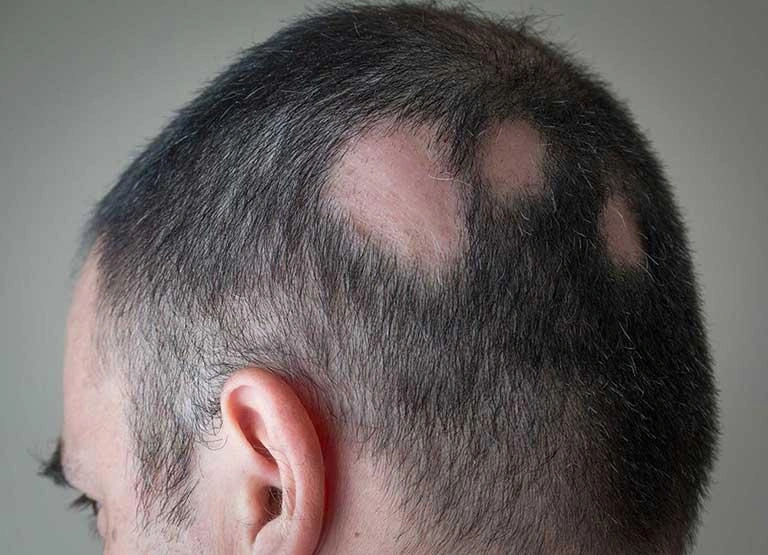
Onset and progression of alopecia areata
Alopecia areata usually begins suddenly, with noticeable hair loss developing over a few days or weeks. Most people first observe one or more smooth, round, or oval patches where hair has been completely lost, typically on the scalp. In some individuals the condition remains limited, while in others it advances to more extensive forms, such as near-total loss of scalp hair (alopecia totalis) or, in rare cases, complete loss of hair across the entire body (alopecia universalis).
Because the condition is immune-mediated and non-scarring, the hair follicles remain structurally intact. However, their normal growth cycle is disrupted, which weakens the anchoring of the hair and causes it to shed prematurely.
A characteristic feature often seen at the edges of bald patches is the presence of exclamation mark hairs. These are short, fragile hairs that are narrower at the base and wider at the tip, giving them the appearance of an exclamation mark. This pattern reflects weakening of the hair shaft close to the scalp.
In essence, alopecia areata is characterized by the sudden appearance of sharply demarcated patches of hair loss, often with distinctive tapered (‘exclamation mark’) hairs that aid in distinguishing it from other hair disorders.
While hair loss can occur for many reasons, alopecia areata has several features that set it apart:
Non-scarring pattern
The scalp remains smooth and unscarred, as the follicles are not destroyed. This preserves the possibility of future regrowth.
Typical clinical presentation
Alopecia areata frequently appears as sharply demarcated circular or oval patches. Examination with dermoscopy may reveal additional signs such as exclamation mark hairs, black dots (broken hairs at the scalp surface), yellow dots (keratin-filled follicular openings), and other markers of follicular activity.
Unpredictable behaviour
The condition varies widely between individuals. Some experience isolated patches that regrow within months, whereas others have recurrent episodes or progressive loss. This contrasts with forms such as androgenetic alopecia, which usually follow a slower, more predictable course.
Possible involvement beyond the scalp
Although the scalp is the most common site, any hair-bearing area can be affected, including eyebrows, eyelashes, beard, and limb hair. In some cases, the condition progresses to extensive or universal involvement.
Autoimmune mechanism
The condition results from an immune response directed at the hair follicle, interrupting the active growth phase (anagen) and causing sudden shedding.
In comparison, other causes of alopecia, such as telogen effluvium or long-standing androgenetic alopecia, tend to show diffuse thinning, gradual progression, or hormone-driven miniaturization, and in some cases may involve scarring or irreversible damage. Recognizing the distinct signs and symptoms of alopecia areata is essential for accurate diagnosis and management.
What are the signs of alopecia areata you should look for?
Several clinical signs are particularly important when assessing a person for possible alopecia areata:
Patchy hair loss
Sudden, smooth, circular, or oval areas of baldness on the scalp or other hair-bearing sites. These patches may expand or merge over time.
Exclamation mark hairs
Short hairs that taper towards the scalp and appear wider at the ends. They often break easily and are typically found at the edges of bald patches.
Black dots and broken hairs
Close inspection may reveal tiny dark dots at the scalp surface, representing hairs broken at or just above the skin. Short, fractured hairs may also be visible.
Yellow dots
Dilated follicular openings filled with keratin and sebum may be seen on dermoscopy, particularly in longer-standing or inactive areas.
Signs of regrowth
Early regrowth usually begins with fine, non-pigmented vellus hairs. Over time, these may be replaced by thicker, pigmented hairs. Upright, short hairs or circular 'pigtail' hairs may appear during this recovery phase.
Itching or tingling
A proportion of individuals notice mild itching, tingling, or discomfort in the affected areas before or during hair shedding.
Taken together, these signs strongly support the diagnosis of alopecia areata and help distinguish it from other causes of hair loss. Prompt recognition and referral to a dermatology specialist can assist in planning appropriate management and improving the chances of successful regrowth.
References
- Akbaba E et al. Alopecia areata: a comprehensive review of clinical, … 2025. Dermatol Ther. 2025. Available at: https://link.springer.com/article/10.1007/s44368-025-00013-8
- Lintzeri D A. Alopecia areata – current understanding and management. J Eur Acad Dermatol Venereol. 2022. Available at: https://onlinelibrary.wiley.com/doi/10.1111/ddg.14689
- DermNet NZ. Alopecia areata: Causes, diagnosis and treatment. Available at: https://dermnetnz.org/topics/alopecia-areata
- Dermoscopedia. Alopecia areata – trichoscopic features. Available at: https://dermoscopedia.org/Alopecia_areata
- Medical Definition of “exclamation point hair”. RxList. Available at: https://www.rxlist.com/exclamation_point_hair/definition.htm
- C Sibbald. Alopecia Areata: an Updated Review for 2023. PM CID. Available at: https://journals.sagepub.com/doi/10.1177/12034754231168839